IEEE-754 Floating Point Representations
| Type | Quiz 1 Material |
|---|
Notes
IEEE-754 Double Breakdown
| 63 (1 bit) | 62...52 (8 bits) | 51...0 (23 bits) |
| 0 | 00000000 | 00000000000000000000000 |
| sign | exponent | mantissa (significant) |
Formula: (-1)^S * 1.M * 2^(E-1023)
- Sign: (-1)^S
- 1 is understood: 1.
- Mantissa (w/o leading 1): .M
- Base: 2
- Exponent: E-1023
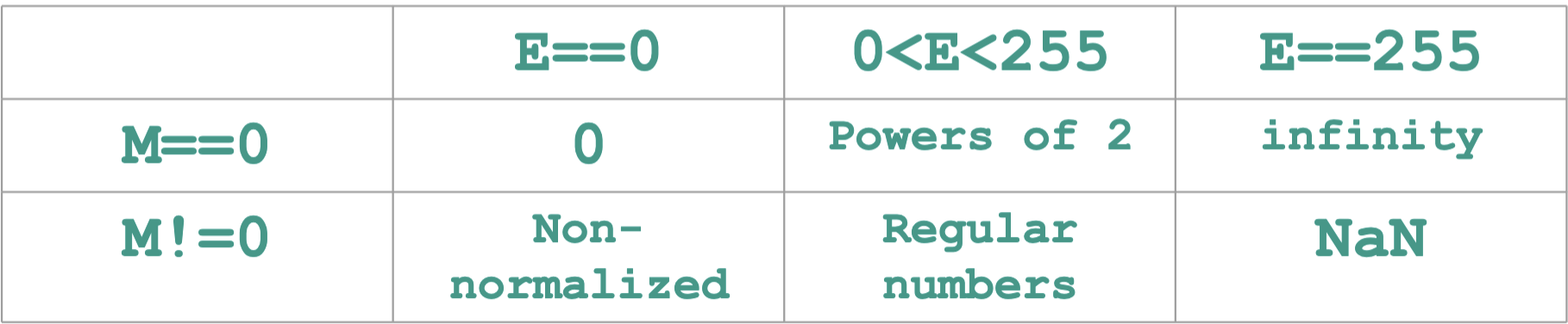
Edge Cases
| E == 0 | 0 < E < 2047 | E == 2047 | |
| M == 0 | 0 | Powers of Two | ∞ |
| M ≠ 0 | Non-normalized typically underflow | Ordinary Old Numbers | Not A Number |
Properties
- Same basic idea as scientific notation
- Precise representation at the bit level
- Precise behavior of arithmetic operations
- Efficiency (Space & Time)
- Special values: not-a-number, +/-infinity, etc.
- Correct rounding
- Sortable without FP hardware
- Edge case for tiny numbers: E==0 is special, so 2-126 is smallest exponent; we use underflow case for anything smaller, like 2-127; note E==0 is computed as E==1
- the 32-bit form the exponent is biased by 127
NaN Properties
- Suppose A is a floating point number set to NaN
- A != B is true, when B is another floating point number, NaN, infinity, or anything
- Interestingly A != A is true as well
- Also, if A or B is NaN, the following are always false:
- A < B, A > B, A == B
Converting variable types
- In CS 1331 we noted:
float f;
int i;
f = i;
i = (int)f;
- What does this imply?
- Converting floats to ints we may lose information
- Converting ints to floats we may lose information
- Converting either way we may lose information
Comparing Two FP Numbers
- The layout of the representation allows certain operations (like > ) to be performed with no conversion
- If either is NaN, the comparison is defined as “unordered” (all comparisons to it except != are false)
- If either is -0.0, replace with +0.0
- If the signs (high bit) are different, the positive number is bigger
- Compare the rest of the bits as integers
- If the signs are both negative reverse the comparison
- Example:
A 0 10111000 11001010 11001010 1100101
B 0 10111000 11101010 11001010 1100101
|B| > |A|
- Treat as 31-bit unsigned whole numbers
- without the sign bits (bit 31)
- And compare the two magnitudes bit by bit, left to right - until you find different values
- Both are positive, so B>A
- Treat as 31-bit unsigned whole numbers
Questions & Answers
What’s the formula for finding what value a regular floating point number represents in terms of its sign, exponent, and mantissa?
How is the exponent represented? What are the range of possible values for the exponent?
- Challenge conceptual question: why do we not use a 2's complement number for the exponent part?
Edge cases
- Given the sign, exponent bits, and mantissa, how can you tell when a floating point number is the following:
- Infinity/negative infinity
- Subnormal (a.k.a. denormalized)
- 0.0 or -0.0
- Power of 2
- NaN
- A regular number (none of the above)
- What does "normalization" mean in the context of IEEE-754?
- What is a subnormal number? How is the formula for computing the value of a subnormal number different from the usual formula?
What are the different values that an IEEE-754 floating point number could represent if:
- It had a mantissa of 00000000000000000000000?
- It had an exponent of 00000000?
- It had an exponent of 11111111?