Quiz 1
| Type | Assessment |
|---|
- Convert the octal number A into the corresponding bases. Assume that A is unsigned. When you type your answer, the prefixes are optional.
A=0o260
Hexadecimal:
8-bit Binary:
Answer
Hex: (B0)16
Binary: 10110000
- A is an octal number being represented as a 8-bit 2's complement number. Is the 2's complement value positive or negative?
A = 571
Answer
Positive ((571)8 = (101111001)2, truncate the left-most bit to get 8 bits. Within the new number, the MSB is 0, and so the number is positive.)
- Fill in the blank in the below statement to satisfy the equation. Assume all numbers are 8-bit. Please give your answer in decimal.
0b10111011 & ~( 1 << ? ) = 0b10101011
Answer
10111011
& 11101111
=10101011
~11101111= 00010000 = (16)10
(16)10 = 1 << 4
—> 0b10111011 & ~( 1 << 4 ) = 0b10101011
- Fill in the below statement to satisfy the equation. Assume all numbers are 8-bit. Please give your answer in 8-bit binary.
(0b10101010 ^ ? ) = 0b11001010
Answer
10101010
^ 01111101
= 11010111
- Fill in the below statement to satisfy the equation. Assume all numbers are 8-bit. Please give your answer in hexadecimal.
0b11100101 << (? >> 0x2) = 0b11001010
Answer
11100101
left shift by 1
=. 11001010
0x4 >> 0x2 = 1
—> 0b11100101 << (0x4 >> 0x2) = 0b11001010
- What could this IEEE number represent based on the given information?
0 ________ 00001110101010000010010
Answer
A positive number or NaN
- What could this IEEE number represent based on the given information?
0 00000000 ________________________________
Answer
either 0 or a non-normalized number
- What is the result obtained by adding the following two 5-bit unsigned binary numbers? Write your answer in 5-bit unsigned binary (ignoring carry-out and do not include spaces in between)
11101 + 01110
The answer for 11101 + 01110 in 5-bit unsigned binary is:
In decimal is:
Answer
5-bit unsigned binary: 01011
Decimal: 43
The answer overflows since it is larger than 31, the biggest number allowed in a 5 bit binary.
12. What is the result obtained by adding the following two 2's complement 5-bit binary numbers? Write your answer in 2's complement 5-bit binary (ignoring carry-out, and do not include spaces in between).
10011 + 10110
5-bit binary:
Decimal:
Answer
5-bit binary: 01001
Decimal: -23
Overflow since carry-in is 0 and carry-out is 1. Also it is larger than -16, the largest negative number allowed in a 5-bit binary.
- What is the result obtained by subtracting the following two 2's complement 5-bit binary numbers? Write your answer in 2's compliment 5-bit binary (ignoring carry-out and do not include spaces in between)
10100 - 01000
Answer
01100
-20
Overflow since carry-in is 0 and carry-out is 1. Also the decimal is larger than -16, the biggest negative number allowed in a 5-bit binary.
16. Given the following truth table, determine what the missing operator is in the corresponding boolean expression:
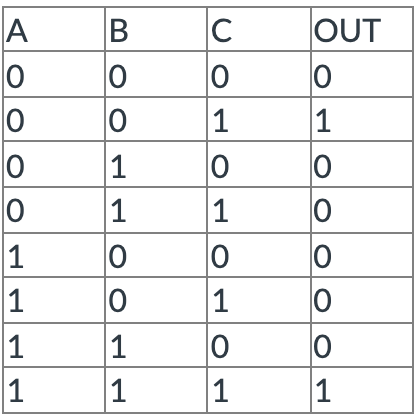
OUT = (A ^ ~B)___C
Answer
Missing Operator: &
- Using DeMorgan’s Law, match the answer choices below to the equivalent logical expressions
A | (B | ~C)
Answer
A | ~(~B & C)
~ (~ A & ~(~B & C))
A & (~B | ~C)
Answer
A & ~(B & C)
~(~A | ~(~B | ~C))