State Machines
| Type | Quiz 2 Material |
|---|
One-hot Scheme
- Requires less amount of combinational logic to decode states
- better time margin
- Good for eco
- Good for FPGA and ASIC
Encoded Scheme
- Requires less # of flops
- Better for ASIC
- not restricted by flops
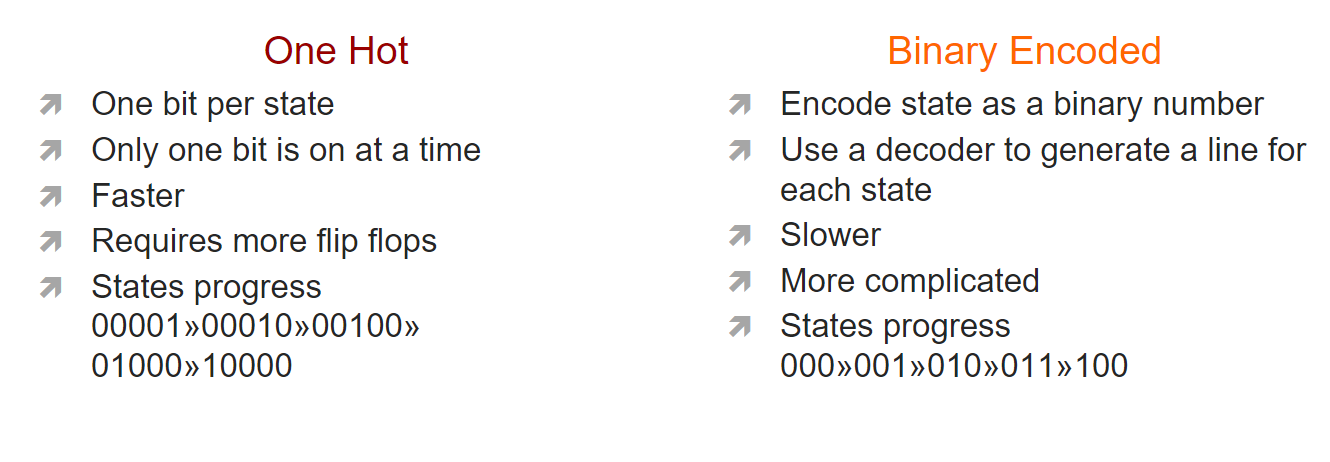
Questions and Answers
What’s the difference between a one-hot state machine and a binary-reduced state machine?
- Binary reduced is basically simplified version of one hot state machine
- Which would generally be faster (in terms of performance/maximum clock speed)?
- One Hot
- Which would generally be easier to create by hand?
- One Hot (see https://edstem.org/us/courses/8915/discussion/645529)
- In the one-hot example, the logic checking the state can simply use the one-hot bits for the multiplexing.
- For the binary-encoded state, the logic has to include a load of decoder logic to convert the binary value to a one-hot value before it can do the multiplexing.
- One Hot (see https://edstem.org/us/courses/8915/discussion/645529)
- Which would generally require fewer logic gates to implement?
- Binary encoded since it’s simplified
Practice converting state diagrams to truth tables and vice versa
- Review both of the problems on Homework 3
Practice reading state machine circuits and translating them to state diagrams
- For example: given the circuit of your one-hot state machine in Homework 3, translate it back into the state diagram without looking at the original
- While you won’t need to actually build state machine circuits like in Homework 3, you should still be comfortable with the concepts from Homework 3.
