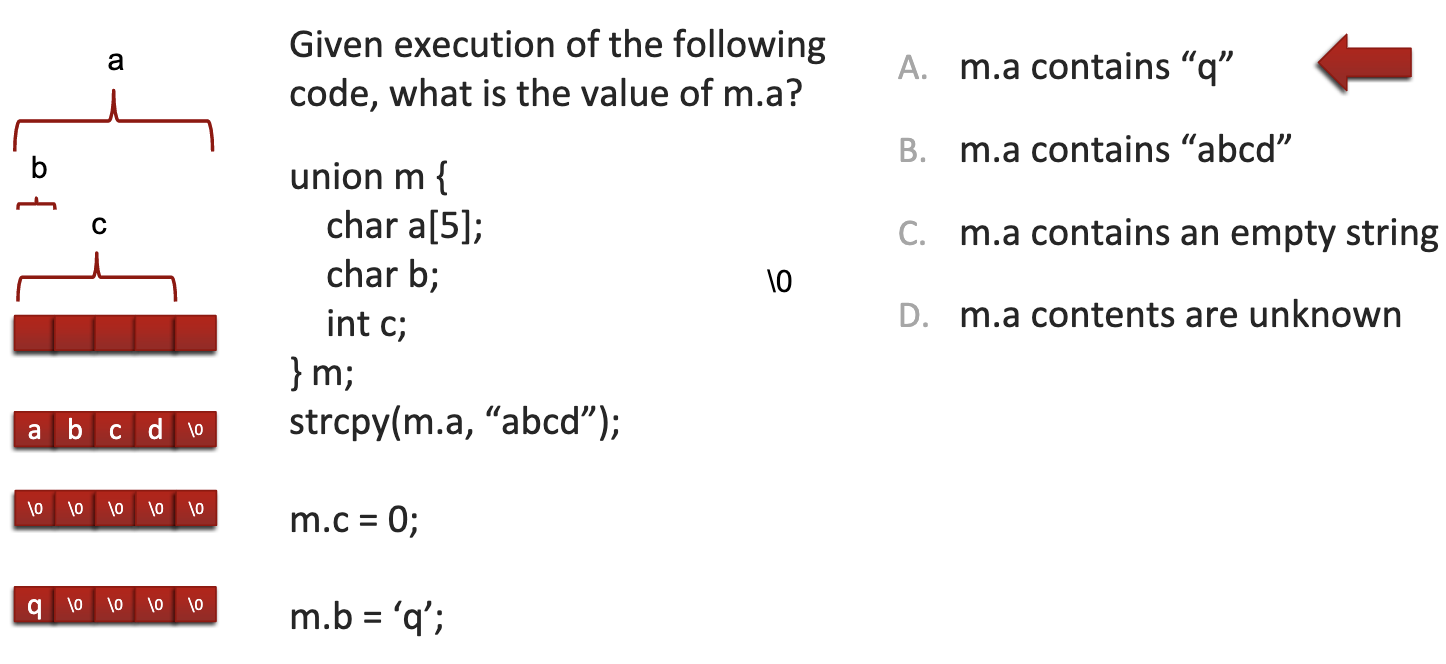
Unions, Function Pointers
| Type | Quiz 4 Material |
|---|
Unions
Union is a user-defined datatype. It is a collection of variables of different data types in the same memory location.
union {
	int myint;
	char mychar;
	char mystr[20];
} myun;
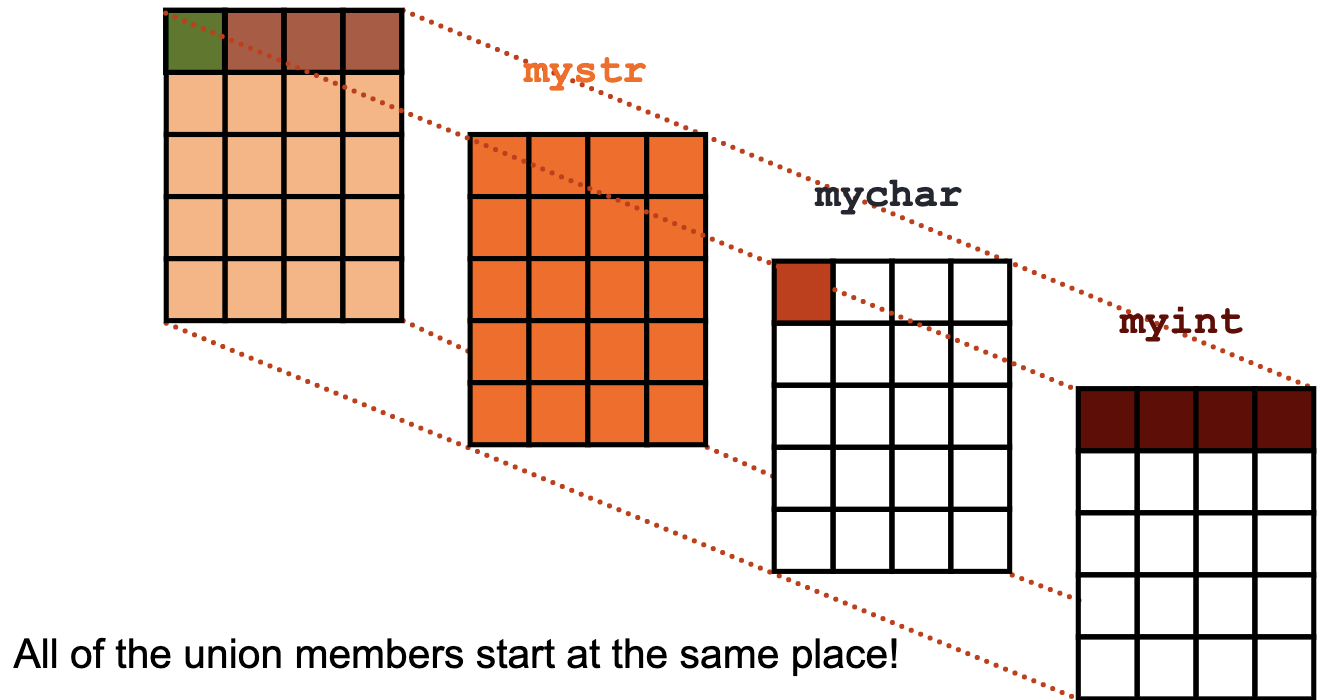
Looks like a struct, and the access is the same as a struct The difference is that all the members have an offset of zero
Unions may:
- Be copied or assigned
- have their address taken with &
- have their members accessed
- be passed as arguments to functions
- be returned from functions
- be initialized (but only the first member)
Unions may not:
- Be compared
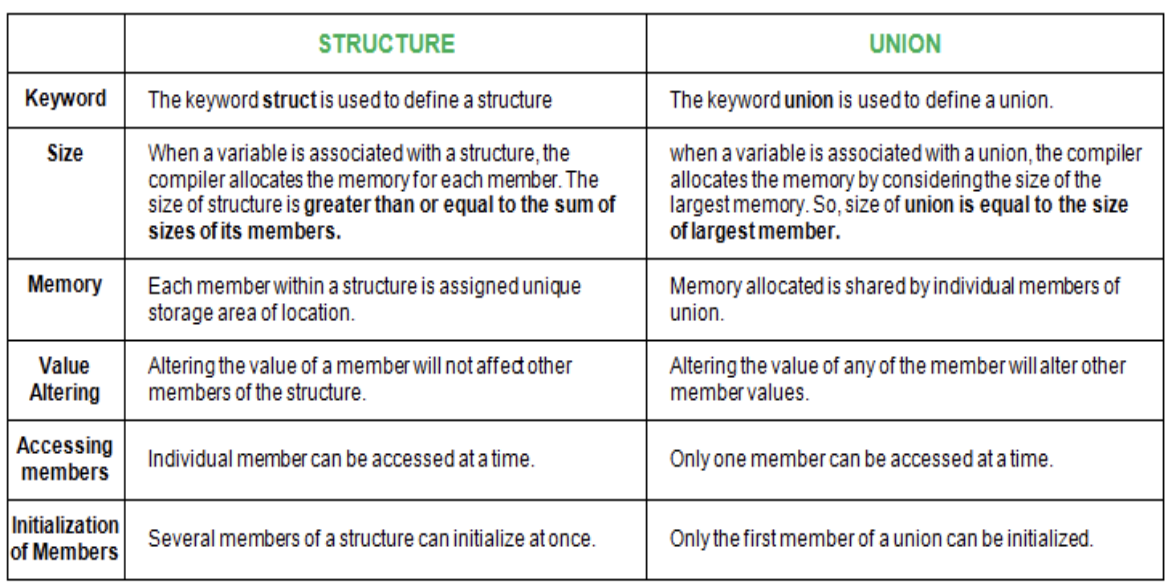
Structure vs Union
Unions in memory with example above
union {
	int myint;
	char mychar;
	char mystr[20];
} myun;

&myun.myint == &myun.mychar == &myun.mystr[0]
sizeof(myun) == sizeof("Largest member")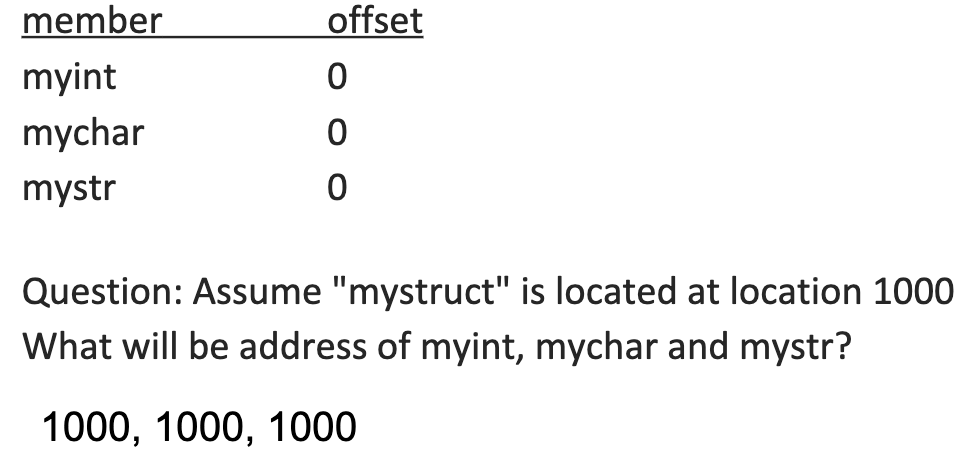
Uses for Union
- Convert between the binary representations of different types; this can be
useful for embedded programming when writing to registers
- Note: this converts between the binary representations, not the values
- For instance, using this to convert 5 to a float would not result in 5.0
- Can be used to implement pseudo-polymorphism
- Use a union to hold the values that are different across the different subclasses
- Have some other variable that determines which union field is valid
- Used to conserve memory when you only need one field
raison d'être
Union is often used in implementing polymorphism found in OOP
Store information about aletes
Information:

struct player {
	char name[20];
	char jerseynum[4];
	char team[20];
	int player_type;
	union sport {
		struct football {...} footbstats;
		struct baseball {...} basebstats;
		struct baseketball {...} baskbstats;
		} thesport;
} theplayer;
theplayer.thesport.footbstats.tds = 3;
Function Pointers
int fi(void)
/* Function that returns an int*/
int *fpi(void)
/* Function that returns a pointer to an int*/
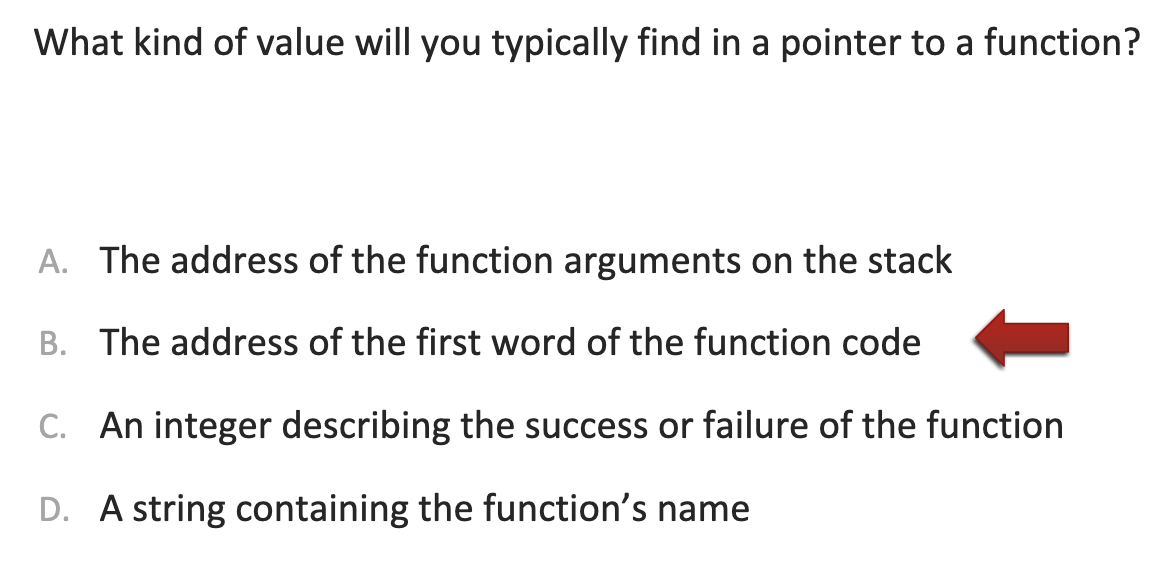
int (*pfi) (void)
/* pfi is a pointer to a function returning int*/
pfi = fi;
/*Legal assigment*/
/*Funciton name without () is the memory address*/
pfi = fi();
/*NO! BAD!*/
/*fi() is a pointer to an int*/
QSort()
Properties
NAME
	qsort - sort an array
ANSI_SYNOPSIS
	#include <stdlib.h>
	void qsort(void *base, size_t nmemb, size_t size,
		int(* compare)(const void *, const void *));
RETURNS
	qsort does not return a result.
PORTABILITY
	qsort is required by ANSI(without specifying the sorting algorithm)
SOURCE
	src/newlib/libc/stdlib/qsort/c
Description
qort sorts an array (beginning at base) of nmemb objects.
size describes the size of each element of the array.
You must supply a pointer to a comparison function, using
the argument is shown as compare. (This permits sorting
objects of unknown properties.) Define the comparison
function to accept two arguments, each a pointer to an
element of the array starting at base. The result of
(*<[compar)>> must be negative if the first argument is
less than the second, zero if the two arguments match, and
positive if the first argument is greater than the second
(where ``less than'' and ``greater than'' refer to what-
ever arbitrary ordering is appropriate).
The array is sorted in place; that is when qsort returns,
the array elements beginning at base have been reordered.
Declaration
#include <stdlib.h>
void qsort(
	void * base,
	size_t nmemb,
	size_t size,
	int (* compar) (const void *, const void *)
)
/*the result of "compar" must be negative if the firs argument is less than the second,
	zero if the two arguments match, and positive if the first argument is greater than the second
	(where "less than" and "greater than" refer to whatever arbitrary ordering is appropriate)*/
Demo
#include <studio.h>
#include <stdlib.h>
#define MAX 100
int compar_ints(const void *pa, const void *pb) {
	return *((int *) pa) - *((int *) pb);
}
int compar_strings(const void *ppa, const void *ppb) {
	return strcmp(*((char **)ppa) , *((char **) ppb));
}
#define MAX 100 int main (int argc, char **argv) { char *strings[] = {"dec", "sum", "IBM", "apple", "hp", "ti", "univac"}; int i, s; int a[MAX]; if (argc == 2 && *(argv[1] == 'a')) { s = sizeof(strings) / sizeof(strings[0]); qsort(strings, s, sizeof(strings[0]), compar_strings); for (i = 0; i < s; i++) { printf(" %s", strings[i]); } print("\n"); } else { for (i = 0; i < MAX; i++) { a[i] = rand() % 100; print(" %d", a[i]); } printf("\n\n"); qsort(a, MAX, sizeof(int), compar_ints); for (i = 0; i < MAX; i++) { printf(" %d", a[i]); } } return 0; }
Question
In-class question 1
In-class question 2